
A strategy game for iPhone and iPad
The Sun is fine. Leave anyway.
Humanity mined its own star to power its climb up the Kardashev scale, and now the Sun is failing. As Director of the Exodus Authority you have until 2166 to research the ships, scan the worlds and send people out, from a real 3D map of our neighbouring stars.
In development at Iron Buffalo Studios. Formerly Planet B-Minus. An iPhone and iPad beta on TestFlight is next.
The premise
By order of the Exodus Authority
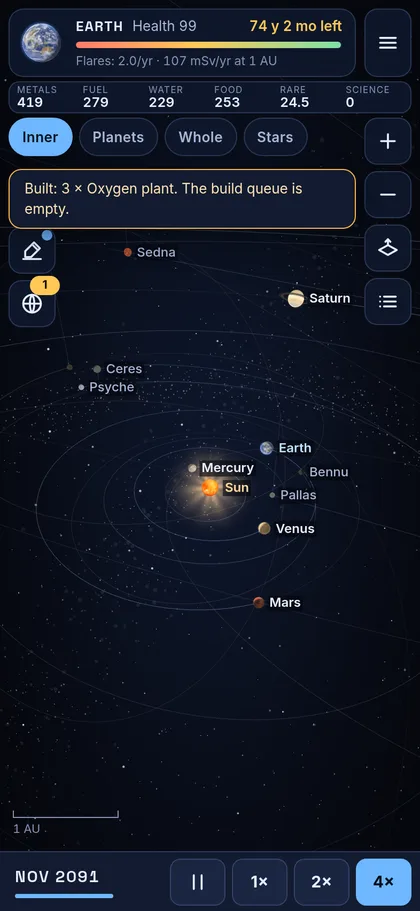
A swarm of collectors around the Sun powers civilisation, and star-lifting mines it for fuel. By 2091 the damage shows: the flares stop behaving and the official line is that the Sun is fine. It is not. In 75 years Earth will not support people out in the open, and there is no perfect second Earth within reach, only worlds that are too cold, too heavy, too dry, too far, or already alive.
You run the Exodus Authority. You choose what to research, what to build, which worlds to scan and who boards. Earth’s factions push back, your council argues, and every year spent learning is a year less to get people there. Spreading out is how humanity survives. It may also be how it gets noticed.
- January 2091The flares begin. The press office says the Sun is fine. The clock starts.
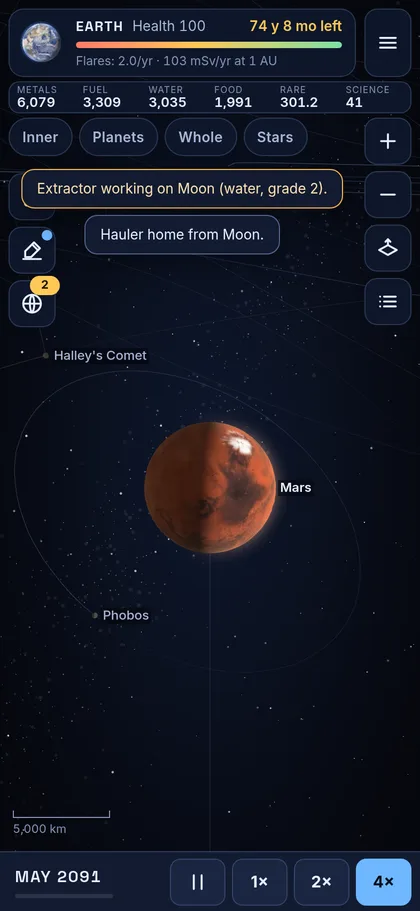
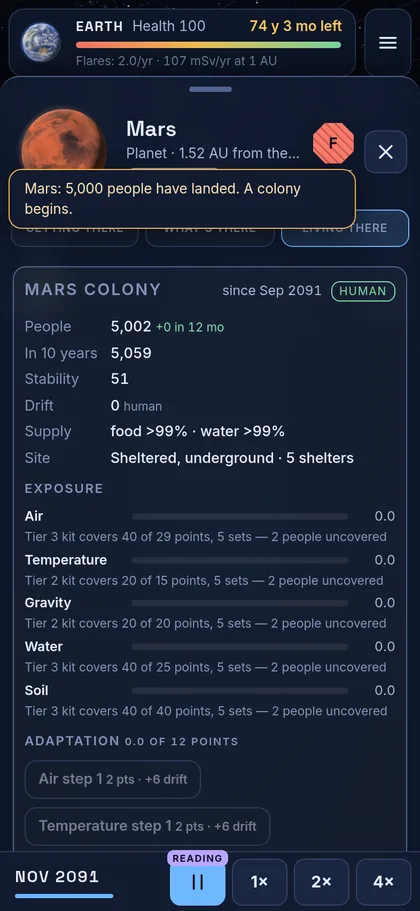
- The first decadesProbes, telescopes and drives. Mars and the Moon are the first steps.
- The middle yearsShips in flight for years, colonies holding on, haulers bringing back what they find.
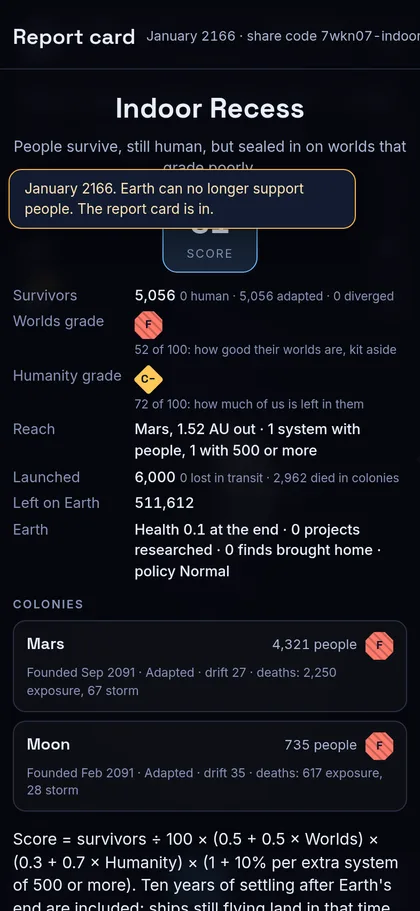
- January 2166Earth is done. An epilogue tells what became of everyone, and a report card grades the worlds you reached.
How it plays
Research. Scan. Launch. Hold on.
One run is 75 years, played at your own pace: pause any time, or run the years at 1x, 2x or 4x.
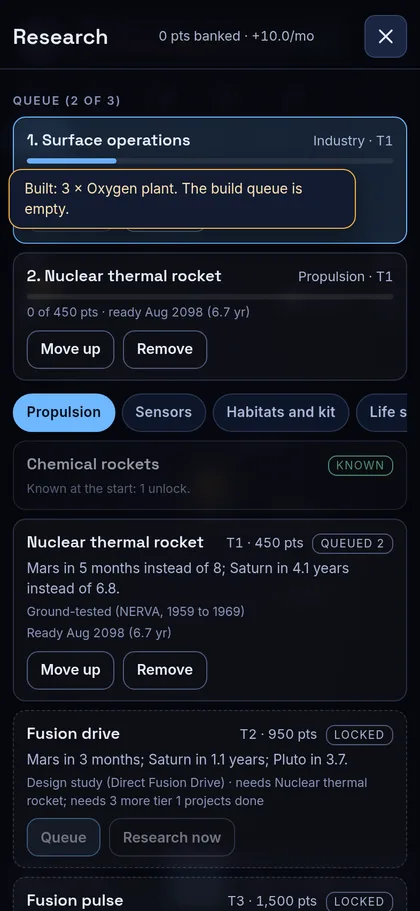
32 projects, from real science
Nuclear thermal rockets, fusion drives, habitats, life support and the kit people need to survive outside. Each one says what it changes and what it is based on.
Know before you go
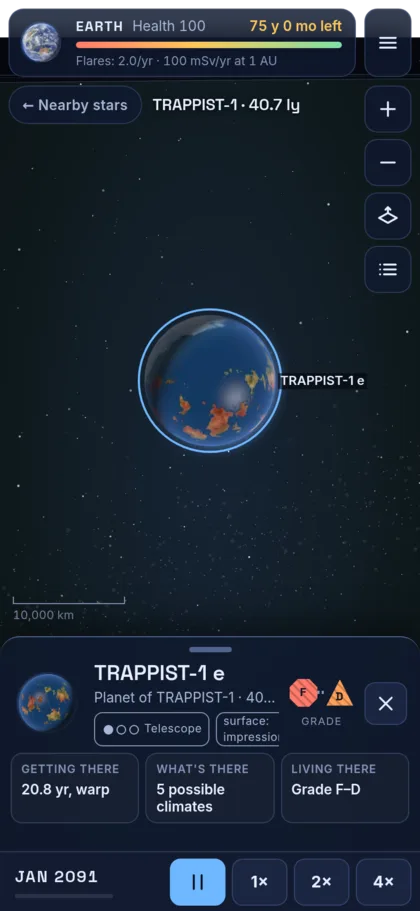
Telescopes, probes and landers turn a dot on the map into a dossier: gravity, temperature, air, water, and what it would take to live there.
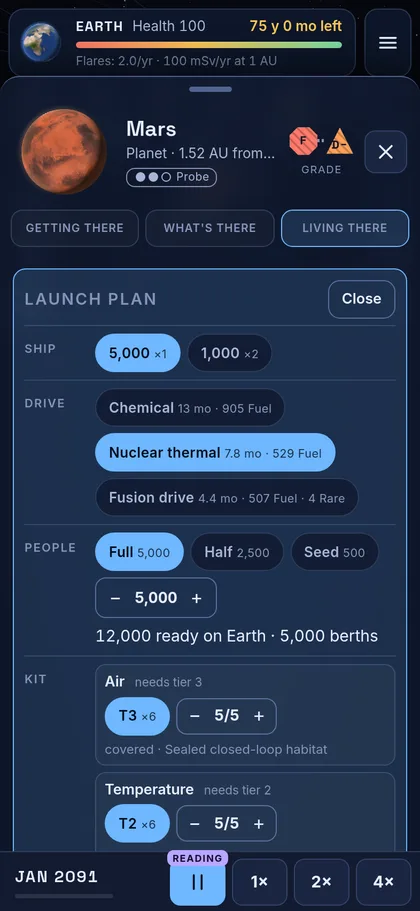
Plan every ship
Choose the ship, the drive, how many people and which kit. The launch plan gives honest odds before anyone leaves, and the ship flies on the map for real years.
Keep them alive
Colonies face exposure, storms, shortages and slow change. Haulers bring extractors, rovers and supplies. Some colonies thrive. Some are lost.
Coming in the full game
Never the same run twice
The game is being rebuilt around the new story. The current beta plays the core loop above; these arrive as development goes on.
Draft your advisors
Pick five advisors from a fresh set of candidates each run, on a budget. Brilliant, corrupt, paranoid, loyal: their traits help and hurt.
Alive, and not friendly
Native ecosystems, colonists who slowly change to survive, and colonies that may decide they are no longer yours.
Ruins, refugees and loot
Probes and expeditions turn up finds from common to legendary, the remains of those who came before, and others fleeing their own star.
A planet in denial
Governments, corporations and the Orbital Force all have opinions. Funding, riots and press releases follow every choice you make.
The science
A real neighbourhood, real distances
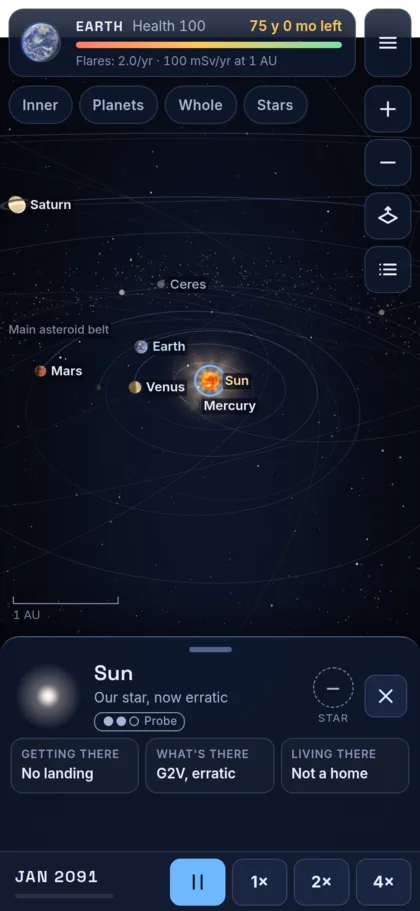
The map is built from published data, so the hard part of the game is the hard part of the real problem: space is big, and ships are slow.
Planet orbits follow NASA JPL data and the nearby stars are placed at their measured distances. No one has photographed the surface of a planet around another star, so those surfaces are artist impressions generated with AI from each world's measured data, and the game labels them as impressions. Solar System surfaces use maps made from spacecraft data.
Beta
Play it first
The iPhone and iPad beta goes out on Apple's TestFlight. Leave your email and you'll get the invite when it opens, plus the occasional dev update. Nothing else.
Your email is used only for the beta and Exodus Authority news, never sold or shared. One email to hello@planetbminus.com removes it. Privacy.
Who's making it
Iron Buffalo Studios
Exodus Authority (formerly Planet B-Minus) is made by Iron Buffalo Studios, an independent game studio in Houston, Texas. The studio also makes Epochfall, Epochfall: Dynasties and Fantasy × AI.